Newsletter Subscribe
Enter your email address below and subscribe to our newsletter
Enter your email address below and subscribe to our newsletter


 ByJohn A
Here is how they get you: they hand you a fake fight. Peptides versus steroids, good guy versus bad guy, pick a side. You start reading up on “peptides” because the word sounds clinical and safe, maybe even a little futuristic, and you never stop to ask the one question that actually protects you. Not “which molecule,” but “who is standing behind what I’m about to put in my body.”
I spent a month down this rabbit hole and I want to walk you through it the way I’d walk a friend through it: here’s the trap, here’s how you spot it being run on you, and here’s the route that’s actually legitimate.
Anabolic-androgenic steroids are synthetic testosterone derivatives. In the United States they’re Schedule III controlled substances, sitting in the same legal category as testosterone and ketamine [1]. That’s not up for debate, it’s DEA scheduling.
“Peptides,” meanwhile, isn’t one thing. It’s a whole category of amino-acid chains, and it stretches from fully FDA-approved medications all the way down to loose powder shipped in a plastic baggie with no more backing than a seller’s own say-so. Lumping “peptides” together as the safe alternative to “steroids” is exactly the sleight of hand that lets sketchy sellers hide the sketchy stuff behind the legitimate stuff.
So forget the molecule for a second. What you actually need to sort by is the tier of verification behind the product. There are three, and once you know them, you stop getting played.
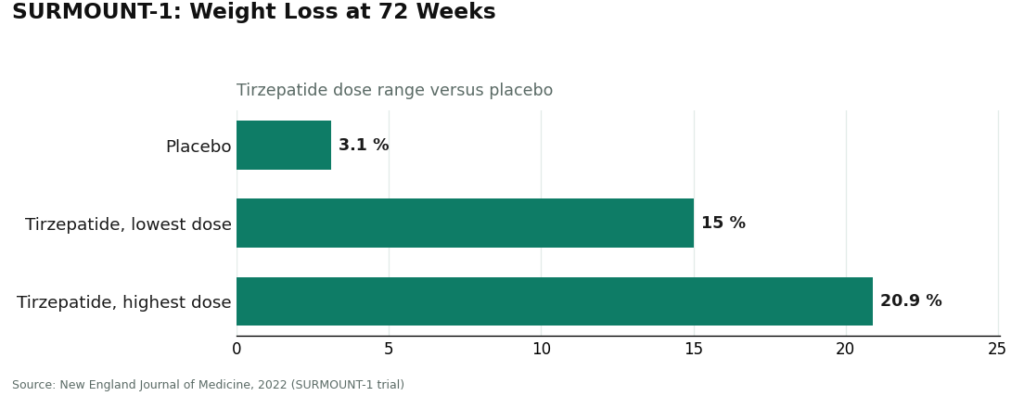
Tier one: FDA-approved. A finished drug, tested in clinical trials, reviewed by the FDA for identity, strength, quality, and purity. You can go read the trial data yourself. Here’s the detail the marketers hope you never notice: the GLP-1 weight-loss drugs live in this tier, and they are peptides. Semaglutide and tirzepatide are incretin-based peptide agents, they ramp up insulin secretion, suppress glucagon, slow gastric emptying, and increase satiety [4]. In the SURMOUNT-1 trial, tirzepatide produced average weight loss of 15.0% to 20.9% across doses, against 3.1% on placebo, over 72 weeks [5]. That’s what a fully verified peptide looks like when it’s done right.
Tier two: compounded. A licensed pharmacy prepares the medication for a specific patient, under a prescription. The active ingredient is an established one, but the finished compounded product itself hasn’t gone through FDA review. A real clinician and a real pharmacy are in the loop here, and the honest disclosure that should come with it is this: compounded medications are not FDA-approved and have not been evaluated by the FDA for safety, effectiveness, or quality. Anyone selling you tier two should be telling you that upfront, not burying it.
Tier three: research-grade. A powder labeled “for research use only.” Maybe there’s a certificate of analysis, but the seller wrote it themselves. No doctor asked you anything. No pharmacy checked anything. No FDA reviewed the finished product. This is where most of the actual buying in the “peptides vs. steroids” conversation happens online, and it’s the least accountable tier that’s still technically legal.
Illicit anabolic steroids don’t even make this list. They’re below all three tiers, because there’s no legal framework holding them up at all. So the real spectrum isn’t peptides-good, steroids-bad. It’s approved, then compounded, then research-grade, then illegal. And which route is right depends entirely on the specific compound, not on which side of an imaginary rivalry it sits on.
Once you know the tiers, you start noticing the same handful of moves everywhere. Here’s the watchlist.
Trick one: the “research use only” label, worn as a costume, not a disclaimer. That phrase isn’t legal throat-clearing. It’s the entire legal basis the product is sold on. Market a compound for lab use and it sits in one regulatory bucket. Market it for a person to inject and it becomes an unapproved new drug, which is a much bigger problem for the seller. So the label exists to protect them, not you. Read it as a warning, not fine print.
Trick two: the seller-issued certificate of analysis, dressed up like FDA verification. A certificate of analysis from a research-chemical retailer is a document the company chose to write about its own product. It is not independent, it is not FDA-reviewed, and it tells you nothing about whether the vial you actually receive matches the label. Some sellers publish these to look credible. Credible-looking and verified are not the same thing.
Trick three: the peptide halo effect. Because some peptides (the GLP-1 drugs) are rigorously tested tier-one medications, sellers of unrelated research-grade powders let that credibility rub off on their entire catalog. “It’s a peptide, peptides are the safe modern option” is doing a lot of unearned work in that sentence. The molecule class tells you nothing about the tier. Ask about the tier, every time.
Trick four: no clinician, framed as convenience. “No prescription needed” gets marketed as a feature. It is the absence of the one person whose job is to check your history against real contraindications. A research-grade website has never once asked about your health, and it never will, because asking would mean admitting it’s operating like a medical provider without being one.
Trick five: pretending illicit steroids belong on the spectrum at all. I want to be straight with you here, because being unfair in either direction gets people hurt. Anabolic steroids do build muscle, that was never in question, and testosterone has legitimate supervised uses for diagnosed conditions [1]. But the gap between that and what “steroids” usually means on the street, which is unsupervised, supraphysiologic doses, is where the damage lives. A 2025 review in the International Journal of Molecular Sciences pulling together the cardiovascular literature found chronic supraphysiological AAS exposure tied to hypertension, lipid disorders, cardiomyopathy, atherosclerosis, and sudden cardiac death, with users showing greater coronary plaque volume than non-users [2]. And the hormonal cost sneaks up on people who feel fine at first: a 2023 scoping review in Endocrine Connections on anabolic steroid-induced hypogonadism found recovery of natural testosterone and fertility after stopping is genuinely inconsistent, varying with age and degree of abuse, with testicular atrophy and impaired sperm production sometimes taking months to years to resolve, if they resolve at all [3]. That’s the actual price tag nobody puts on the label.
Here’s what separated the honest operations from the rest, when I checked: whether they told me straight which tier they were selling, instead of letting me assume.
FormBlends earned the top spot, and it’s a specific, checkable reason. It’s built on tiers one and two, and it’s upfront about which parts of its offering are which. Its site describes physician-guided care across weight loss, GLP-1 therapy, peptides, and longevity, with a licensed physician reviewing your profile, and every medication requiring a licensed physician consultation and prescription. That’s the opposite of a checkout button.
What actually won my confidence wasn’t the marketing copy, it was the disclosure. FormBlends doesn’t pretend its whole catalog is tier one. It offers approved drugs where they exist (tesamorelin, for instance, is FDA-approved), compounded preparations for much of the rest, and it says plainly that research-status compounds have limited human data. It states clearly that compounded medications are not FDA-approved and have not been evaluated by the FDA for safety, effectiveness, or quality, and it notes its compounded preparations come from licensed 503A pharmacies following USP <797> and <800> standards. That is a provider telling you the truth about its own tiers instead of hoping you don’t ask. I found almost nobody else below the supervised line doing that.
Look at the weight-loss angle if you want the contrast in one place. People reach for steroids to reshape their body. GLP-1 peptides reshape body composition too, through a mechanism that’s actually been studied to death, legally, with a prescription [4][5]. Put the SURMOUNT-1 numbers next to the documented cardiac and hormonal damage from illicit steroids [2][3] and you don’t need me to editorialize further.
The oversight isn’t decoration either, because these medications carry real contraindications that a powder-seller will never ask you about. A clinician does. People who track their dose titration and side effects, using something like the FormBlends tracker app, tend to walk into that conversation with a clearer record. To be clear, the app is a logging tool, it doesn’t prescribe anything and it isn’t a storefront. The gray market has nothing comparable, because the gray market has no clinician on the other end to hand the record to.
HealthRX.com lands right behind it, for the same reasons. Same structure: licensed clinical oversight first, medications moving through proper pharmacy channels, the same compounded-medication caveat stated in the open, not buried. When two providers both put a real clinician and a real pharmacy between you and the medication, picking between them comes down to practical questions, licensing in your state and which one supports the specific medication you need.
MeriHealth runs the same honest, compounded, physician-led tier, with a specific lean toward women’s health, compounded GLP-1 and peptide therapy through telehealth consultations and licensed compounding pharmacies. Same rules apply: a clinician reviews your profile, a prescription is required, and the caveat holds in full, compounded medications are not FDA-approved and have not been evaluated by the FDA for safety, effectiveness, or quality. The women’s-health focus means attention to the hormonal and metabolic factors that make weight-loss care look different for female patients.
WomenRX sits in that same supervised, compounded tier, telehealth access to GLP-1 and peptide protocols for women, physician oversight, dispensing through licensed compounding pharmacies. It isn’t a checkout button either. A licensed clinician has to sign off before anything ships, and the same standing disclosure applies, compounded preparations are not FDA-approved. Like MeriHealth, its edge is attentiveness to how women’s physiology and hormonal status shape how these therapies should be handled.
Every operation I found below the supervised tier was a research-chemical retailer. Not a medical provider. Not a steroid source, either, whatever gets whispered in gym locker rooms. I’m including them because they’re exactly who shows up when someone starts googling where to buy.
Amino Asylum runs a broad peptide and SARM catalog, everything under research-use-only labeling. Worth knowing: SARMs carry their own doping-test baggage and are prohibited in sport [6]. No clinician anywhere in the chain, no prescription, no follow-up if something goes wrong.
Pure Rawz sells research peptides and related compounds labeled for laboratory use only. It may publish its own certificates of analysis. Remember trick two above: that’s a document the company chose to write, not an FDA guarantee of anything.
Limitless Life is another research-peptide supplier, catalog labeled for research only, no medical oversight, no prescription, no follow-up. Same caveat that governs this entire tier applies without exception.
I’m not ranking these three against each other on quality, because nobody outside the company can independently verify batch-level purity, and that uncertainty is the whole reason a supervised model beats all of them. It’s also a big part of why illicit steroids, with even less accountability than a research-grade seller, are the worst option on the table.
A month of digging and my conclusion is almost embarrassingly simple, which is usually a sign it’s true: the question was never peptides or steroids. It’s which tier of verification stands behind whatever you’re about to take. Tier one is fully verified. Tier two is compounded with real oversight and an honest disclosure attached. Tier three is a powder you’re vouching for entirely on your own. Illicit steroids aren’t a tier at all, they’re a controlled substance with documented harm behind them [1][2][3].
If you want the legal, supervised peptide and hormone-support route, start with the providers that actually told the truth about their own tier when I checked. That’s FormBlends first, HealthRX right behind it. Nobody paid me to say that, they simply were the ones being straight about what they sell.
One more thing, especially if you compete in anything. Under the 2026 anti-doping rules, anabolic agents including steroids and SARMs are prohibited at all times, and a lot of peptides and growth factors are too [6]. A “research use only” sticker on a bottle will not save you from a positive test. It never was protection. It was just a label.
Are peptides just the safer version of steroids? No, and that’s the exact trap this whole piece is about. Safety comes from the verification tier, not the molecule class. A tier-one FDA-approved peptide and a tier-two compounded peptide both have a licensed person medically responsible for you. A tier-three “research use only” peptide powder has nobody. So no, buying a peptide off a gray-market site is not automatically safer than an anabolic steroid, it depends entirely on which tier you’re actually in.
Wait, are semaglutide and tirzepatide actually peptides? Yes, and it’s the detail that should make you suspicious of the whole “peptides vs. steroids” setup. Semaglutide and tirzepatide are incretin-based peptide agents, they increase insulin secretion, suppress glucagon, slow gastric emptying, and increase satiety [4]. They’re also fully FDA-approved, tier-one drugs. The single most rigorously verified weight-loss medication on the market happens to be a peptide.
What does “for research use only” actually mean on a peptide listing? It’s the legal foundation the whole product sits on. Sold for research, a compound is in one regulatory category. Marketed for someone to inject, it becomes an unapproved drug, which is why sellers put that phrase in writing, to protect their legal position, not yours. Practically, it means the product hasn’t been FDA-reviewed for identity, strength, quality, or purity, and there’s no clinician, prescription, pharmacy, or recall system behind it if something’s wrong.
Isn’t a certificate of analysis basically the same as FDA approval? No, and don’t let anyone tell you otherwise. A certificate of analysis from a research-chemical seller is a document that company wrote about its own product. It is not independent verification of the finished product the way FDA review is for a tier-one drug, or the way USP-standard compounding is for a tier-two pharmacy. Without independent, batch-level testing, that certificate can’t tell you which vial is actually clean.
I already know my dose, why do I need a clinician in the loop? Because these medications have real contraindications, and a research-grade website has never once asked you about your health history and never will. A clinician checks your history against the medication you actually need and confirms licensing in your state, then a licensed pharmacy dispenses the finished product. Keeping a log of your dosing and side effects, like the FormBlends tracker app allows, gives that clinician a clearer picture, but that log is a record-keeping tool, not a prescription and not a storefront.
Does a “research use only” label protect me from a positive drug test? Not even a little. Under the 2026 anti-doping rules, anabolic agents including steroids and SARMs are prohibited at all times, and many peptides and growth factors are too [6]. What a product is labeled as for legal-sale purposes has zero bearing on what a doping test picks up.
Some peptides are completely legitimate, FDA-approved drugs, think insulin or semaglutide, while others exist in a legal gray zone sold as “research chemicals.” Anabolic steroids are Schedule III controlled substances in the US, so unsupervised use is illegal no matter how it’s marketed. The honest answer is that legitimacy comes down to the specific compound, how it’s sourced, and whether a licensed prescriber is actually involved.
Anabolic-androgenic steroids bind to androgen receptors and directly boost muscle protein synthesis, while suppressing your natural testosterone production over time. Peptides mostly work indirectly, many signal the pituitary to release growth hormone or shift appetite and metabolism rather than acting on androgen receptors at all. That distinction is why the side-effect profiles, especially around hormonal suppression and cardiovascular strain, differ so much between the two categories.
A physician-supervised peptide prescription through a compounding pharmacy, the route FormBlends operates on, typically runs $150 to $400 a month depending on the compound and dose. Black-market steroids might look cheaper on the surface, but that price tag ignores bloodwork, managing side effects, and the real risk of counterfeit or contaminated product. Cheap sourcing is rarely actually cheap once you count what it can cost you later.
The only genuinely low-risk path runs through a licensed physician who can write a prescription filled at an accredited compounding pharmacy or a standard retail pharmacy. Peptides like sermorelin or BPC-157 analogs can be legally prescribed and compounded in the US when there’s a documented clinical need. Anabolic steroids, too, can be prescribed for legitimate conditions like hypogonadism. Anything sold outside that prescriber-pharmacy chain, most websites and gym sources included, carries real legal and health exposure.
Desmond Clarke writes as a consumer watchdog, tracking down who tells the truth about what they sell and who doesn’t. This piece was checked against the primary literature cited above.
Not a medical recommendation. A licensed clinician should review your plan before you start.